

From Curiosity to Confidence: How STEM Kits Shape a Child’s Learning Mindset
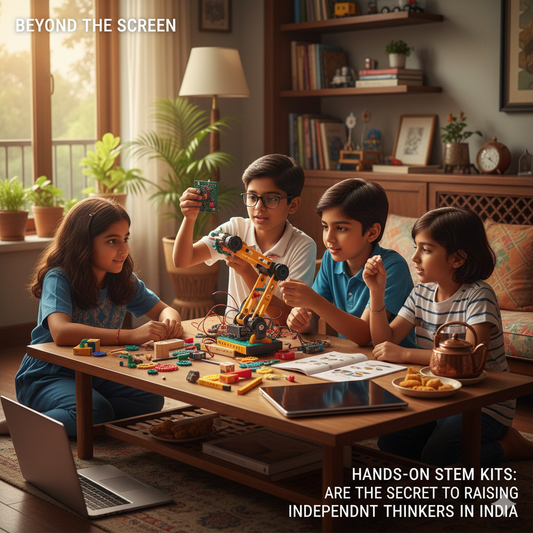
Building a growth mindset is the most valuable gift a parent can give in today’s competitive landscape. In India, where "Topper Culture" often prioritizes marks over mindset, hands-on STEM (Science, Technology, Engineering, and Mathematics) kits are quietly changing the game.
Every Indian parent knows the "Why?" phase.
"Why is the sky blue?" "Why does the fan spin?" "Why do I have to eat green veggie?"
While curiosity is natural, confidence—the belief that they can find the answers themselves—is built. In an era dominated by screens and rote memorization, hands-on STEM kits are emerging as the bridge between a curious child and a confident problem-solver.
1. Moving Beyond the "Rote Learning" Trap
The traditional Indian education system is famous for its rigor, but often falls into the trap of Rattta (rote learning). STEM kits flip this script. Instead of memorizing the definition of "Force" or "Friction" from a textbook, a child feels it while building a balloon-powered car or a hydraulic crane.
Indian parents are increasingly searching for "Experiential Learning" and "NEP 2020 compliant toys." A&M world kits align perfectly with the New Education Policy’s focus on practical, play-based learning.
2. The Power of "Beautiful Failures"
In many Indian households, "failure" is a scary word. But in the world of STEM, failure is just data.
When a child builds a circuit and the LED doesn't glow, they don't see a "Red Mark" on a paper. They see a puzzle.
- Is the wire loose?
- Is the battery drained?
- Did I flip the switch?
This iterative process builds a "Growth Mindset"—the understanding that intelligence isn't fixed; it grows with effort and troubleshooting.
3. Engineering "Focus" in a Distracted World
With the rise of short-form videos (Reels and Shorts), attention spans are shrinking. STEM kits are "slow-release" entertainment. They require:
- Sequence: Following a 10-step manual teaches patience.
- Precision: Aligning gears correctly develops fine motor skills.
- Stamina: Staying with a project for 45 minutes without a screen "dinging" is a superpower in 2026.
4. Why it Matters for the Indian Parents
Today`s Indian parents don't just require degree holders—they require innovators.
By introducing STEM kits early, you are giving them the "Maker’s Spirit." You are teaching them that they aren't just consumers of technology; they are the creators of it.
Comparison: Watching vs. Doing
|
Feature |
Educational Videos (Passive) |
STEM Kits (Active) |
|
Retention Rate |
Low (approx. 10-20%) |
High (up to 90%) |
|
Mindset |
"I know what this is." |
"I know how to build this." |
|
Confidence |
Intellectual (Theory) |
Practical (Capability) |
|
Screen Time |
Increases Eye Strain |
Reduces Digital Fatigue |
Key Takeaway for Parents
The transition from "I don't know how" to "I can figure it out" is the most important milestone in a child's development. STEM kits provide the safe space for this transition to happen.
When you buy a STEM kit, you aren't just buying a toy. You are buying a moment where your child realizes: "I built this. I solved this. I am capable."
Tags:
Related articles
Kitchen Volcano Experiment
Oct 01 2025

Build a Balloon Car
Oct 01 2025
Make a Paper Helicopter Fly!
Oct 01 2025